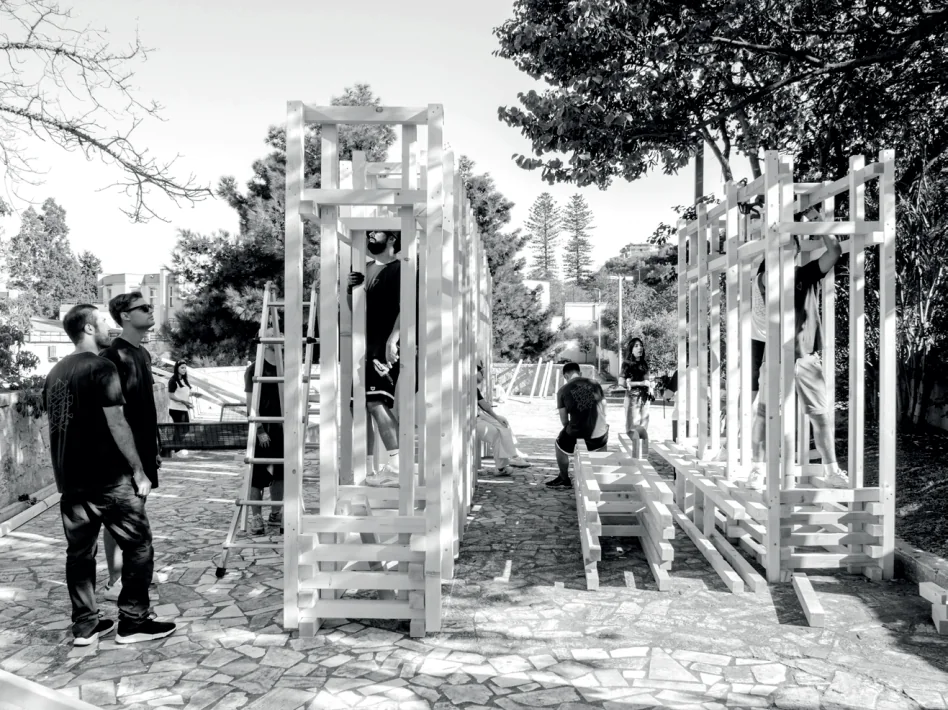
UNICA SPACE FORCE is a group of professors, researchers, and students from the University of Cagliari — coordinated by the School of Architecture of the Department of Civil & Environmental Engineering and Architecture — which promotes design and self-construction workshops to construct generative habitats in urban and rural contexts.
Scientific coordinators
Carlo Atzeni, Ivan Blečić
Teachers
Michele Agus, Chiara Cabras, Stefano Cadoni, Giulia Giliberto, Andrea Margagliotti, Francesco Marras, Silvia Mocci, Emanuel Muroni, Maria Carla Saliu
2013
2014
2015
2016
2017
2018
2019
2020
2021
2022
2023
2024
2025
2026
Thought hours:27.068
Action hours:35.721
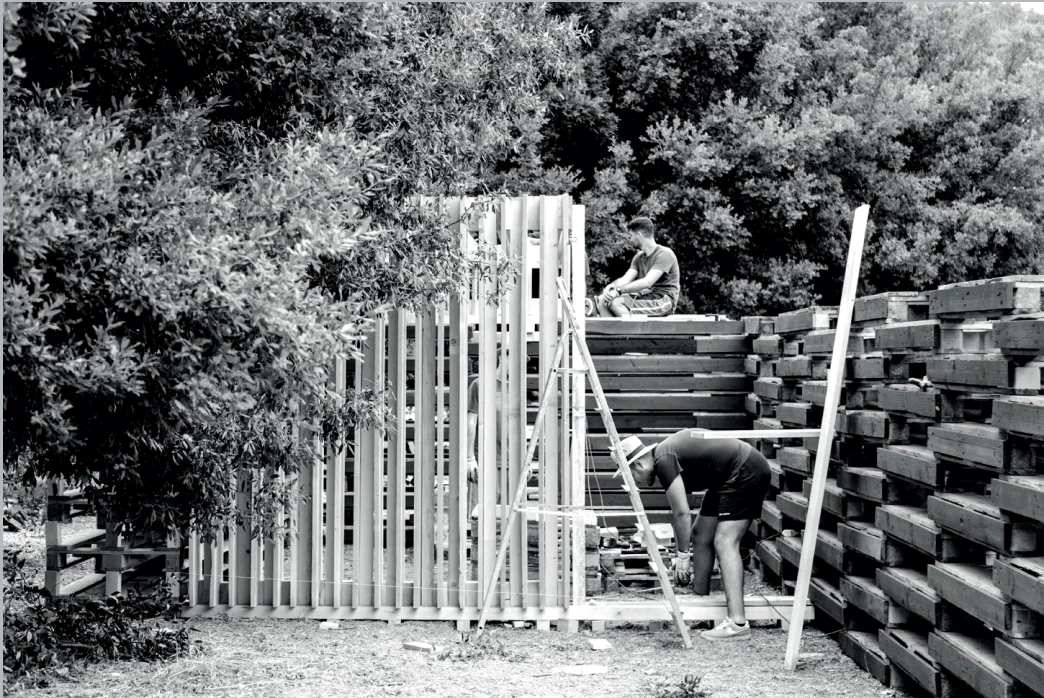
Timber posts5.000Boards1.800Pallets1.000Panels400
the estimated hours are calculated based on an average commitment of 8 hours per day per participant
Animated gallery of anonymous participant portraits
Doing by Learning
In architecture schools, the design atelier is an established practice in teaching the design disciplines. It works with real or realistic places and subjects, often agreed with institutional interlocutors. It addresses context, the different scales of design, the relationships it involves and activates, structure, construction, matter, sustainability, accessibility and the concrete feasibility of proposals.
This is the principle of learning by doing: design becomes an instrument of knowledge through action.
In conventional teaching practices, however, this action remains confined within a formative simulation. It produces drawings, models, prototypes or semi-finished objects that support learning but exhaust their function within the course, atelier or workshop.
UNICA Space Force reverses this perspective.
Not only learning by doing, but doing by learning. One does learn by doing, but here one truly does by learning, and learns more precisely because truly doing.
The product of the process does not end with its teaching function. It is a generative architecture complete in its own measure and responsibility: a real object intended to remain in place, to be used, modified, recognised, criticised and maintained.
The commitment to a real outcome brings to the centre aspects that simulation does not activate with the same intensity: matter, safety, precision, feasibility, maintenance, time, public use and responsibility towards people and places.
Image 1 of 3
Thought and action
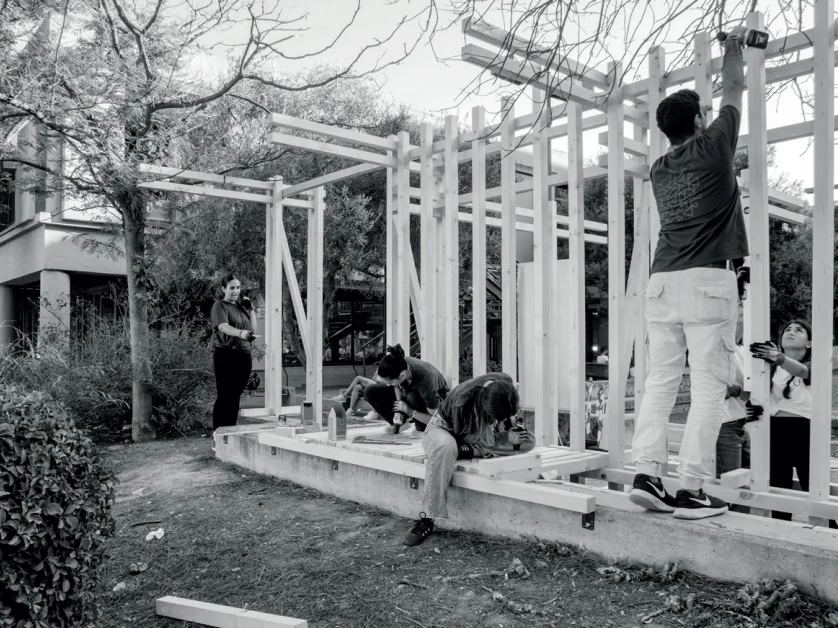
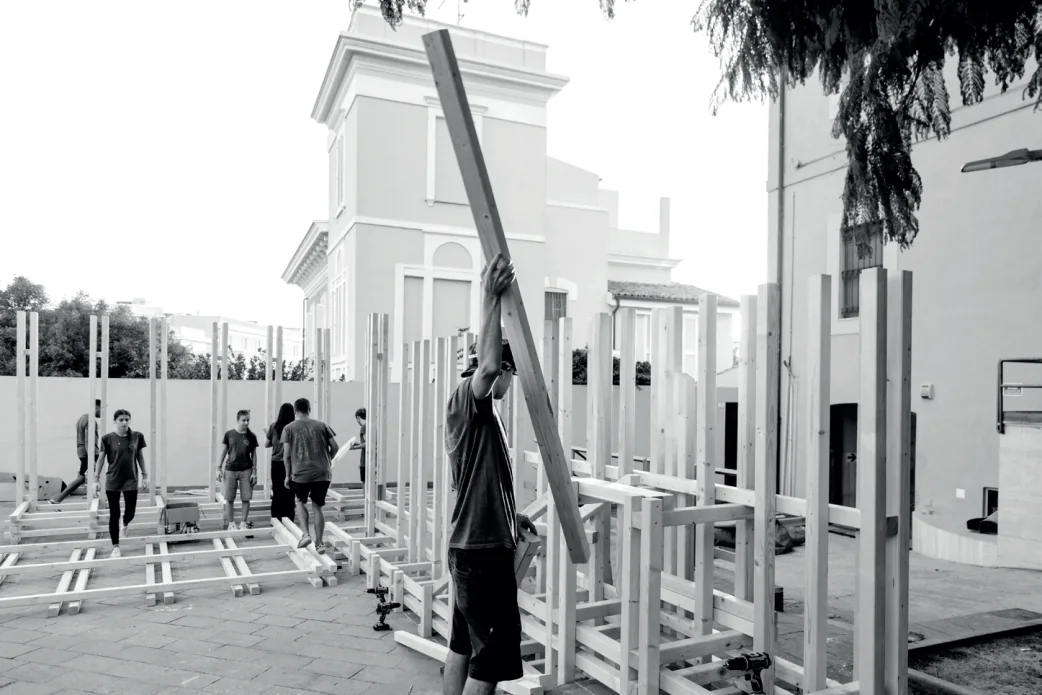
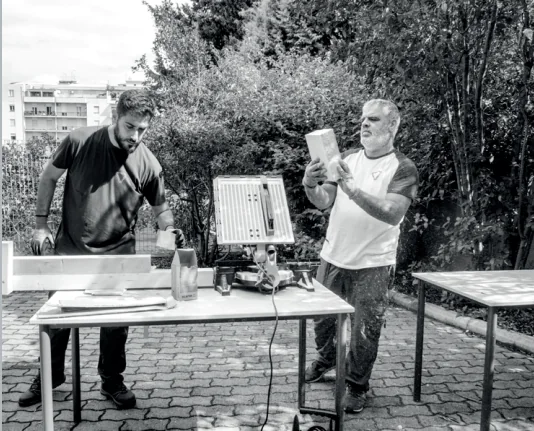
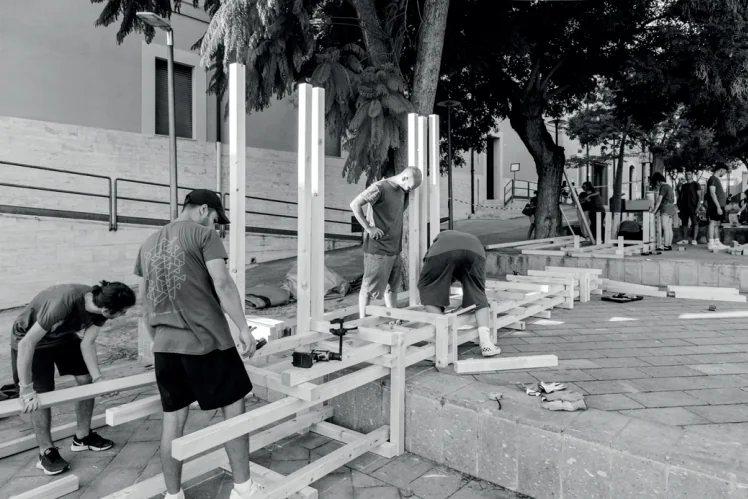
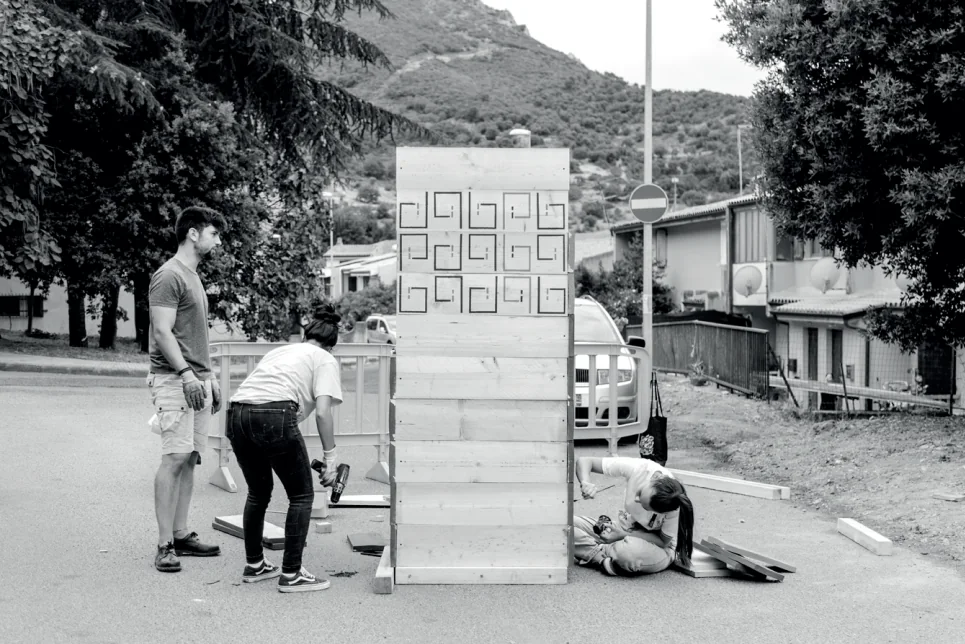
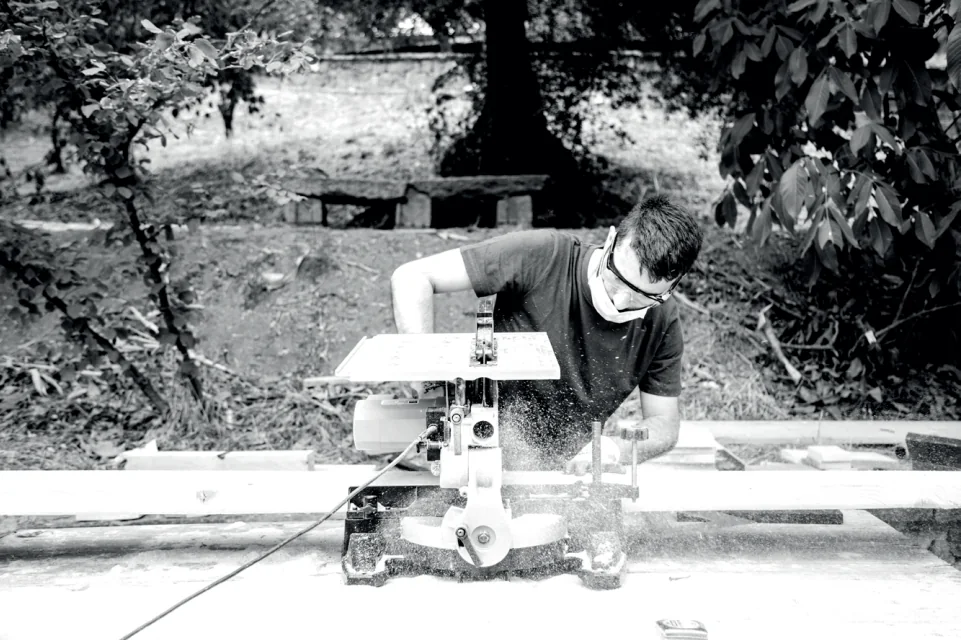
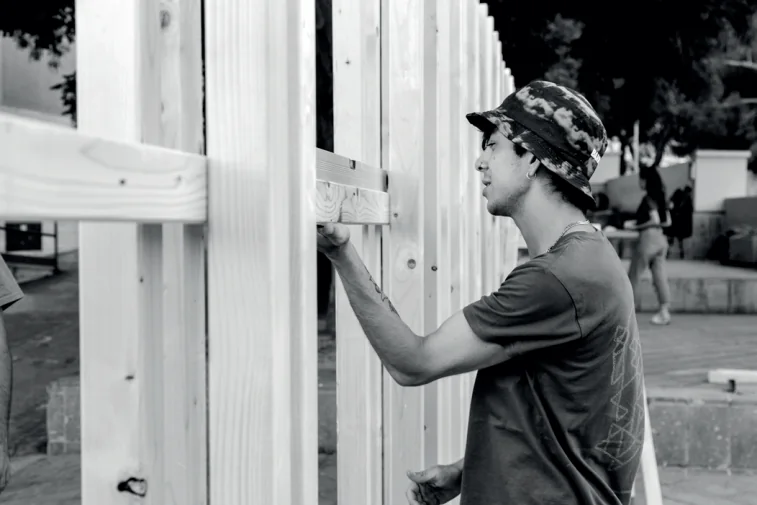
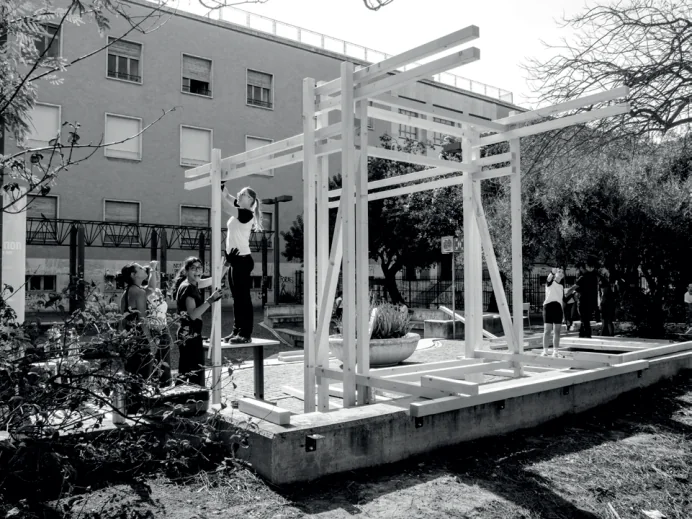
Since 2012, the UNICA Space Force research and teaching group at the University of Cagliari — composed of teachers, researchers and students from the School of Architecture — has developed summer schools, intensive workshops and educational micro-construction sites.
The size and scale of the design process are reduced to focus the project on the possibility of a concrete, self-built outcome.
Thought and action are not independent moments.
Design guides construction; construction tests design. Decisions are measured against the available matter, techniques, resources and time.
Self-construction is not merely the execution stage of a process already completed. It is a stage of learning and part of the project itself.
Those who take part in the micro-construction sites share knowledge, responsibility, work and results. The concrete dimension of teaching develops ethical awareness and responsibility in students and involves them in caring for places and communities.
Doing by learning means confronting design in its entirety. Idea, matter, time, cost, safety, use and care can no longer be considered separately.
Image 1 of 3
Generative Habitats
Through practices of thought and action, design workshops and self-construction, UNICA Space Force produces Generative Habitats in urban, rural and university contexts across Sardinia.
A Generative Habitat is a system of architectural devices that acts on abandoned or undervalued public space, reveals its unexpressed potential and multiplies its possibilities of use.
It does not establish a definitive configuration. It introduces transitional conditions capable of adapting and developing over time.
The objective is to improve the habitability of forgotten, underused or suspended spaces: to make the passage from site to place, returning presence, use and shared meaning to space.
Generative Habitats are pulsating spaces. They support processes of reappropriation and return multiple, open and changing uses to communities.
The project does not claim to complete the transformation. It enters a longer process, constructs its first concrete condition and leaves subsequent possibilities open.
Image 1 of 3
Much thought, few resources
UNICA Space Force adopts the principle of much thought and little money as a design discipline.
Working with few resources does not mean renouncing quality. It means choosing, measuring and testing; simplifying without impoverishing; distinguishing what is necessary from what is superfluous.
When a project must become real construction, scarcity is not only a technical or financial constraint. It is a pedagogical condition. It forces the ambitions of the project into relation with the means actually available.
This economy produces architectures based on low technologies, recyclable materials and, whenever possible, short supply chains. Architectures that are light in their use of resources but precise in their intentions.
It is an architecture made of much thought and few resources, capable, with conscious realism, of being poor but beautiful.
Poverty of means does not mean poverty of design. On the contrary, it focuses the project.
The principle of necessity also becomes a paradigm of renunciation: of the superfluous, the costly, the large scale, the absence of a programme and the difficulty of managing spaces over time.
It is not a renunciation of architecture, but of what weakens its precision and responsibility.
Image 1 of 3
Design, time, transformation
The construction of a place is a long-term process. It is the result of sedimentations, negotiations, balances, conflicts and successive transformations.
No project can consider itself definitive.
UNICA Space Force therefore approaches the processual and transitional dimension as an opportunity. Interventions realised with few resources and in short periods can respond to urgent needs while initiating more durable processes of transformation that require greater time and resources.
The time of architecture is not always aligned with the time of people. Rapid, responsive and adaptive projects can reduce this distance and limit the risks of decisions made under conditions of uncertainty.
Provisionality and reversibility do not indicate a lack of completeness. They indicate the capacity to leave subsequent paths open.
Architectures can be adapted, developed, replicated and transformed. The prototype enables limited serial production and variations capable of responding to different places.
The uniqueness of an intervention does not exclude replication. Varied replication can build relationships between places and contribute to a coordinated and recognisable territorial image.
Placing objects lightly on the ground means intervening without fixing the destiny of places once and for all. It means caring for them while leaving them open to change.
Image 1 of 3
Ecology and sustainability
Generative Habitats express an ecological approach based on low technologies, recyclable materials and reducing the use of non-renewable resources.
But sustainability does not concern matter, techniques or the containment of resources alone.
There is another face of sustainability: the cultural one. It is the capacity to maintain and reproduce over time the principles that regulate relationships within communities and ensure their autonomy.
Sustainability is therefore environmental and cultural.
UNICA Space Force connects conventional uses — those that guarantee resident care of the land and the continuing management of countryside or city — with new uses capable of renewing the meaning of places.
Design gives form and structure to this relationship. It does not merely record initiatives arising from communities, but translates them into concrete, rapid and adaptive disciplinary action.
It does not seek to eliminate uncertainty. It operates within it, limits risk and keeps possibilities of adaptation open.
The project responds through pragmatism, concreteness and responsibility.
Image 1 of 3
People, city, territory
The true objective of the projects is people and their needs.
To design means to construct, integrate and improve the conditions through which places can be inhabited. It means creating habitats.
The interventions concern more than the form of the objects constructed. They concern the relationship between communities and territories, between existing and new uses, between permanence and transformation.
They are architectures for people, for the city and for the territory.
They operate in forgotten and abandoned places, but also in places of excellence, through uses that are neither invasive nor disruptive. They construct new connections between local production, cultural use, care of the landscape and new forms of habitability.
They contribute to the long duration of places not by freezing their present image, but by recognising that habitats are constructed through transformations, disturbances and subsequent consolidations.
Doing by learning means transforming education into real and responsible action.
It means producing architecture while constructing knowledge, skills and awareness.