
The construct of humanisation was developed within the field of healthcare environment design, with reference not only to socio-relational aspects, but also to physical-spatial ones1.
It is now widely recognised that the physical-spatial attributes of places can influence people’s health both by generating feelings of wellbeing or discomfort, and by conveying positive or negative information for people’s self-esteem, security, and identity2. The proposal is therefore to design and organise spaces based on the needs and expectations of the people who occupy and use a given environment, from a user-centred perspective3, in which design characteristics may play a role in promoting the health and wellbeing of communities.
As already mentioned, the construct of humanisation emerged in relation to the design of healthcare environments, where the need became apparent for a design more focused on people (“patient-centred” or, more generally, “user-centred” rather than on architectural and medical technology. As stated by Arneill and Devlin4, the assumption that a healthcare facility should be designed as a ‘healing machine’ for medical conditions, rather than as an environment to promote the wellbeing of the individual, is being challenged.
The broader concept of humanisation refers to a range of aspects (organisational, social, relational, functional, and physical-spatial) that characterise a healing environment. According to this perspective, organisational and management issues play a significant role both in improving the service and in making the user’s experience more comfortable. This point highlights the importance of the physical environment both as the context for human relationships and behaviours, and as a key factor influencing the way in which the experience of the place is perceived5.
In the field of healthcare environment design, the objective of “more human hospital environments”6 or “humanising healthcare environments”7 refers to the architectural design attributes that healthcare facilities should possess in order to: (i) reduce levels of stress, which may be very high for both patients and caregivers given their daily contact with illness, pain, and (in some cases) death; and (ii) promote and enhance the wellbeing and quality of life of staff.
From a spatial-physical perspective, the construct of humanisation is embodied through attention to a set of design attributes aimed at meeting users’ fundamental needs8. These needs include spatial and sensory comfort (in visual terms – that is, adequate lighting and scenic views – auditory terms – that is, avoiding disturbing noise – and climatic terms – that is, adequate temperature and humidity), orientation, a sense of welcome, privacy, social interaction, perceptual coherence, control over space, and restorativeness. In this regard, design attributes to be considered include spatial layout and configuration; colours and materials of furniture, walls, and floors; artworks; type, quantity, and focus of natural and artificial light; views; window size; cleanliness; and climate.
In sum, promoting a higher level of physical-spatial humanisation of a place means taking into account its architectural configuration in order to increase comfort and facilitate relationships among the individuals who occupy and use that place.
Urban humanisation
Although the construct of spatial-physical humanisation has been used in relation to a specific context such as healthcare environments, it is also appropriate with reference to other contexts, such as urban spaces and the relationship between the built environment and human wellbeing. The growing attention towards urban wellbeing stems from the awareness that physical environments profoundly influence emotions, behaviours, social relationships, and quality of life. Recent research also confirms that the experiential quality of urban space is closely linked to mental health, environmental satisfaction, and the subjective wellbeing of residents9. From this perspective, urban space is no longer interpreted merely as a functional support for human activities, but as an experiential and relational environment capable of fostering inclusion, wellbeing, and social cohesion. The emotional and perceptual dimension of the city therefore assumes a central role in contemporary urban design, especially in relation to the growing homogenisation of globalised urban landscapes and the loss of local identity10.
Accelerated urbanisation, densification processes, and the economic transformations of recent decades have often produced urban contexts characterised by spatial fragmentation, loss of local identity, and the impoverishment of social relations. Many contemporary suburbs are marked by phenomena of physical degradation, social marginalisation, lack of quality public spaces, and a reduction in opportunities for interaction among residents. In such contexts, the need clearly emerges to rethink urban design from a human-centred perspective, oriented not exclusively towards infrastructural efficiency or property enhancement, but towards the creation of urban environments capable of responding to the emotional, social, and cultural needs of local communities11.
According to the perspective of “human-centred design”12, designing humanised urban environments means focusing on needs, perceptions, and everyday practices of the people who live in and use the space. This approach implies overcoming a technocratic vision of urban planning, through the promotion of participatory and multidisciplinary design processes for integrating architectural, social, psychological, and ecological aspects. In this sense, contemporary urban planning increasingly engages with post-humanist and relational approaches that interpret the city as a complex ecosystem of interactions among individuals, environments, and technologies (Jon, 2020).
Urban humanisation is expressed through a plurality of interconnected dimensions: environmental comfort, accessibility, aesthetic quality, presence of greenery, social inclusion, perceived safety, spatial orientation, opportunities for social interaction, enhancement of local identity, and residents’ participation in decision-making processes. These elements contribute to the construction of welcoming, legible, and recognisable places for generating place attachment, sense of community, and psychological wellbeing14.
Reflection on the humanisation of urban space is also connected to the theoretical contributions of scholars such as Jane Jacobs15, Kevin Lynch16, Jan Gehl17, and Henri Lefebvre18, who highlighted the importance of public space as a site of social interaction, identity construction, and democratic life. Jacobs emphasised how urban vitality depended on the presence of active and diversified public spaces capable of encouraging spontaneous encounters and widespread social control. Lynch instead highlighted the role of urban legibility in shaping the mental image of the city and strengthening the sense of orientation and belonging. Gehl focused attention on the human dimension of urban design, promoting cities designed “for people” rather than for cars. Lefebvre, finally, through the concept of the “right to the city”, interpreted urban space as a collective good and a site of social production.
More recent reflections on the relationship between urban space and human experience also highlight how the design of public spaces directly influences individuals’ cognitive, relational, and emotional processes. According to Gruosso et al.19 public space may be interpreted as a true cognitive extension of human experience, capable of shaping behaviours, perceptions, and modes of social interaction.
Within this theoretical framework, urban regeneration assumes a meaning that goes beyond the simple physical redevelopment of degraded spaces. Regeneration means activating integrated transformation processes capable of intervening simultaneously on the spatial, social, cultural, and economic dimensions of territories. Humanisation therefore becomes one of the guiding principles of contemporary urban regeneration, insofar as it directs design towards the creation of inclusive, relational, and socially sustainable environments.
In this perspective participatory processes and self-build practices are highly relevant20. Involving residents in the design and transformation of public spaces facilitates the development of positive appropriation of places, strengthens the sense of collective responsibility, and enhances local knowledge. Thus, participation represents not merely an operational tool, but rather a central element of urban humanisation, since it restores to residents an active role in defining everyday living environments. Participatory dynamics also encourage the construction of social trust and strengthen neighbourhood relational networks21.
Urban humanisation in action:
the TERSICORE project
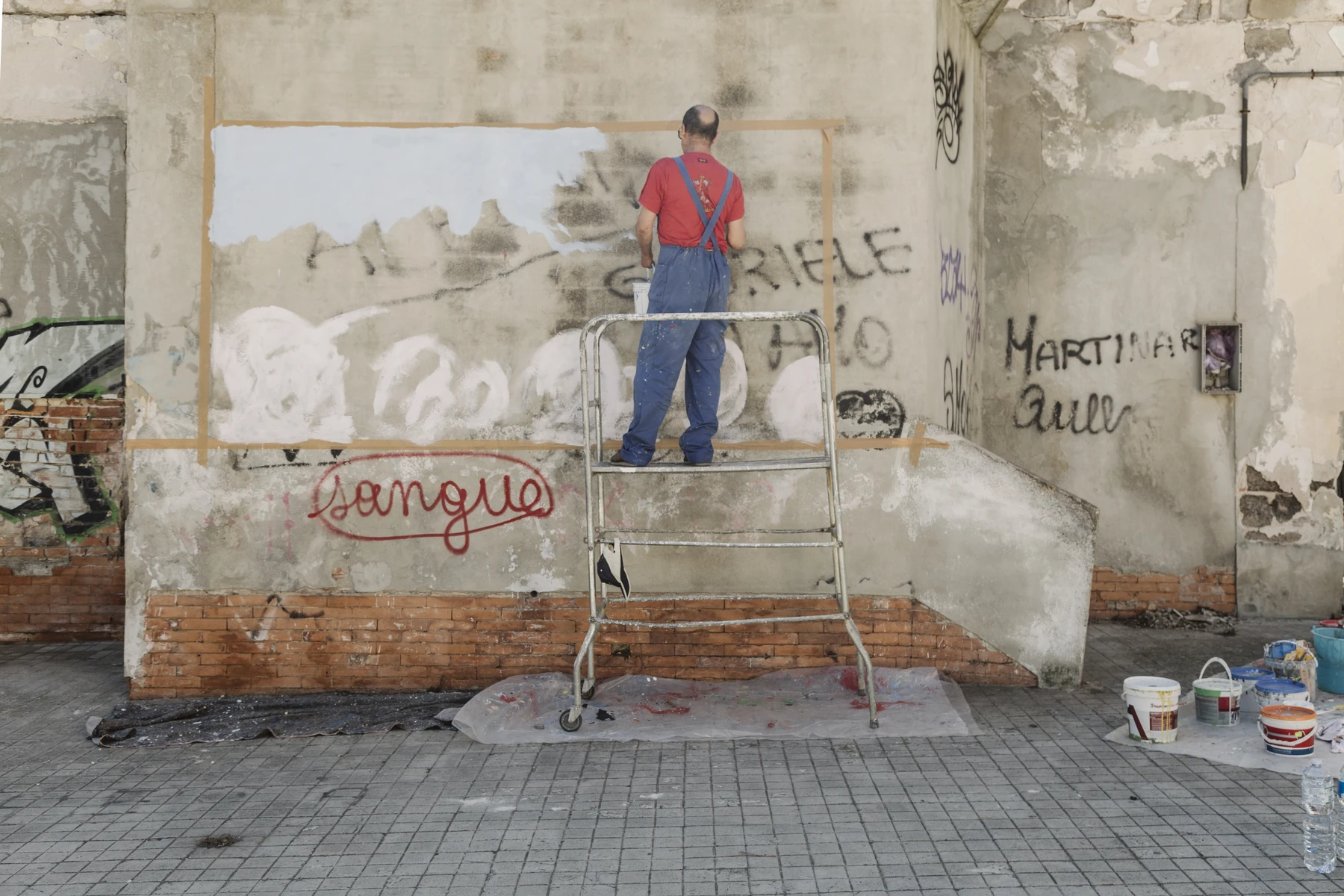
The TERSICORE project, developed in the “Nucleo Sacripanti” of the Is Mirrionis neighbourhood of Cagliari, constitutes an emblematic case of this approach. Through participatory design practices, self-build activities, and psycho-social analysis of spaces, the project experimented with innovative forms of urban regeneration aimed at fostering collective wellbeing and social inclusion. The intervention is situated within an urban context characterised by socio-spatial marginality and fragility, but at the same time endowed with significant relational and community potential. The Is Mirrionis neighbourhood represents a significant example of the transformations that have affected many Italian urban suburbs in the post-war period. The intervention in the “Nucleo Sacripanti” had the aim to reverse this process through a strategy focusing on the collective reappropriation of public space. The so-called “square without a name”, together with the surrounding spaces and the abandoned former school building, became the symbolic place of a regeneration process founded on social activation and residents’ participation.
Self-build practices should aim to physically transform spaces through the direct involvement of the local community in the creation of urban furniture, installations, and micro-redevelopment interventions. Such practices produce significant effects not only on the material level, but also on the symbolic and relational one. Participating in the construction of space indeed means developing forms of collective identification and strengthening the emotional bond with the place.
From a theoretical point of view, this approach is linked to reflections on “placemaking”, understood as a collaborative process of producing urban space based on the needs and aspirations of local communities. Placemaking emphasises the role of everyday experience and social practices in constructing meaningful places, in contrast with standardised and top-down models of urban planning22. Another central element of urban humanisation concerns the relationship between public space and psychological wellbeing. As reported in scientific literature, the quality of urban environments affects mental health, perceptions of safety, and individuals’ stress levels. Degraded, noisy, or identity-less spaces may generate alienation, anxiety, and emotional detachment, whereas accessible, green, and relational environments foster processes of psychological regeneration and social inclusion23.
A specific role is played by urban greenery. In fact, the presence of vegetation and nature in public spaces promoted both environmental and psycho-social benefits: it improves climatic comfort, reduces pollution, encourages physical activity, and contributes to the reduction of mental stress24. It was also evidenced that the ecological and perceptual quality of urban environments influence the way people construct their environmental identity and develop sustainable attitudes25.
In the case of the TERSICORE project, re-naturalisation interventions played a fundamental role in the process of transforming spaces. The shared care of flowerbeds, the planting of vegetation, and the collective maintenance of green spaces encouraged the development of collaborative practices and neighbourly relations. The emotional dimension of urban experience also constitutes an increasingly relevant theme in contemporary participatory design practices. Innovative tools such as experiential walks26, emotional mapping27, and digital applications28 make it feasible to collect data concerning the perceptions, emotions, and interpretations that residents associate with urban places.
Through these tools, it becomes possible to understand not only how spaces are used, but also how they are experienced and perceived. Digital and immersive technologies, such as augmented reality and participatory three-dimensional modelling, may further contribute to the humanisation of the design process, making future urban transformations more accessible and comprehensible. In this perspective, technology is not interpreted as an element of separation between citizens and designers, but as support for the shared construction of urban space. Furthermore, new reflections on digital urban aesthetics show how technological devices increasingly influence the sensory and symbolic perception of contemporary public spaces29.
In conclusion, as also emphasised by Ricciardelli et al. 30, urban regeneration processes prove to be more effective when they integrate aesthetic, social, and organisational dimensions oriented towards social innovation and the construction of collective values. From this perspective, the city is reinterpreted not merely as an infrastructural system or economic device, but as a space of life, experience, and relationships. Urban humanisation thus becomes a fundamental principle for promoting social sustainability, inclusion, and quality of life in contemporary cities.
Notes
1. Romano Del Nord, Donatella Marino, Gabriele Peretti, Humanization of care spaces: a research developed for the 459 Italian Ministry of Health, in Techne - Journal of Technology for Architecture and Environment n.9, Firenze 2015, pp. 224-229.
2. Gary W. Evans, Janetta Mitchell McCoy When buildings don't work: he role of architecture in human health. Journal of Environmental Psychology, 18, pp. 85-94.
3. Donald A. Norman, The Psychology of Everyday Things, Basic Books, New York 1988.
4. Alyssa B. Arneill, Ann Sloan Devlin, Perceived quality of care: the influence of the waiting room environment, in Journal of Environmental Psychology, 22, 2002,
pp. 345-360.
5. Ferdinando Fornara, Claudia Andrade, Healthcare environments. In S. Clayton (edited by.), The Oxford Handbook of Environmental and Conservation Psychology, Oxford University Press, New York 2012, pp. 295-315.
6. Yasushi Nagasawa, The geography of hospitals, in S. Wapner, J. Demick, T. Yamamoto, & H. Minami (edited by), Theoretical perspectives in environment-behavior research, Kluwer, New York 2000, pp.217-227.
7. Victoria Bates, Humanizing healthcare environments: architecture, art and design in modern hospitals, in Design for Health, 2, 2018, pp. 5-19.
8. Ferdinando Fornara, Claudia Andrade, Op.cit.
9. Marica Cassarino, Sina Shahab, Sara Biscaya, Envisioning happy places for all: A systematic review of the impact of transformations in the urban environment on the wellbeing of vulnerable groups, in Sustainability, 13(14), 2021.
Ade Kearns, Suhail Ghosh, Phil Mason, Matt Egan, Urban regeneration and mental health: Investigating the effects of an area-based intervention using a modified intention to treat analysis with alternative outcome measures, in Health & Place, 61, 2020.
10. Adrienne Grêt-Regamey, Marcelo Galleguillos-Torres, Global urban homogenization and the loss of emotions. Scientific Reports, 12(1), 2022.
11. Praveen Kasula, Aysin Dedekorkut-Howes, Heidi Shearer, Scott Baum, Social inclusion of urban villages: A systematic review of global urban planning practices. in Cities, 169, 106509, 2026.
12. Donald A. Norman, Op.cit.
13. Ilhyun Jon, A manifesto for planning after the coronavirus: Towards planning of care, in Planning Theory, 19(3), 2020, pp. 329-345.
14. Marino Bonaiuto, Ferdinando Fornara, Stefano Ariccio, Ugo Giovanni Cancellieri
Leila Rahimi, Perceived residential environment quality indicators (PREQIs) relevance for UN-HABITAT City Prosperity Index (CPI), in Habitat International, 45, 2015, pp. 53-63.
15. Jane Jacobs, The Death and Life of Great American Cities, 21(1), Random House, New York 1961, pp. 13-25.
16. Kevin Lynch, The Image of the Environment and The City Image and Its Elements, in Kevin Lynch, The Image of the City, Mit Press, Cambridge 1960, in The urban design reader, Routledge 2013.
17. Jan Gehl, Cities for People, London, London 2013.
18. Henri Lefebvre, The urban revolution, University of Minnesota Press, 2003.
19. Stefania Gruosso, Marcella Del Signore, Andrea Di Cinzio, The extended mind of public space: how urban design shapes human experience, in Frontiers in Built Environment, 11, 2025.
20. Andrea Manunza, Giulia Giliberto, Emanuel Muroni, Oriana Mosca, Ferdinando Fornara, Ivan Blečić, Marco Lauriola, “Build It and They Will Stay”: Assessing the Social Impact of Self-Build Practices in Urban Regeneration, in Urban Science, 9(2), 30, 2025.
21. Siobhan C. Heath, Anna Rabinovich, Manuela Barreto, Exploring the social dynamics of urban regeneration: A qualitative analysis of community members' experiences, in British Journal of Social Psychology, 62(1), 2023, pp. 521-539.
22. John Pendlebury, Heleni Porfyriou, Heritage, urban regeneration and place-making, in Journal of Urban Design, 22(4), 2017, pp. 429-432.
23. Marica Cassarino, Sina Shahab, Sara Biscaya, Envisioning happy places for all: A systematic review of the impact of transformations in the urban environment on the wellbeing of vulnerable groups, in Sustainability, 13(14), 2021.
24. Roger S. Ulrich, View through a window may influence recovery from surgery, in Science, 224(4647), 1984, pp. 420-421.
Rachel Kaplan e Stephen Kaplan, The experience of nature: A psychological perspective. Cambridge University Press, Cambridge 1989.
25. Janice Meis-Harris, Yoshihisa Kashima, Navigating sustainably within the urban environment: The role of environmental identity and attitudes on sign and object evaluation, in Asian Journal of Social Psychology, 23(4), 2020, pp.407-421.
26. Barbara Ester Adele Piga, Nicola Rainisio, Gabriele Stancato, Marco Boffi, Mapping the in-motion emotional urban experiences: An evidence-based method, in Sustainability, 15(10), 2023.
27. Jiří Pánek, Emotional maps: Participatory crowdsourcing of citizens perceptions of their urban environment, in Cartographic Perspectives, (91), 2018, pp.17-29.
28. Oriana Mosca, Ferdinando Fornara, Gian Luca Pia, Valeria Pinna, Andrea Manunza, Ciro Salis, Marco Castiglione, Sergio Benoni, Giulia Desogus, Ivan Blečić, Experiences of urban places mediated through pervasive games: An empirical study of place-based psychological responses, in Cities, 171, 2026.
29. Monica Degen, Gillian Rose, Conceptualising aesthetic power in the digitally-mediated city, in Urban Studies, 61(11), 2176-2192, 2024.
30. Alessandra Ricciardelli, Pasquale Amoruso, Francesco Di Liddo, Urban Regeneration: From Design to Social Innovation—Does Organizational Aesthetics Matter?, in Urban Science, 9(3), 79, 2025.